

A Vital Part of the Water Treatment Package
Cooling towers are essential to heat exchange in commercial and industrial facilities, but they also provide favorable conditions—warm water, nutrient-rich environments, and oxygen saturation exposure— for microbial growth. Without proper water treatment, this can lead to:
- Biofilm formation, which greatly reduces heat transfer efficiency at the heat exchanger
- Microbiologically influenced corrosion (MIC), which damages assets via under-deposit corrosion and pitting from film-forming anaerobic bacteria
- Legionella outbreaks, which pose serious health risks and regulatory consequences
To address these risks, cooling tower water treatment programs include biocide chemicals, especially oxidizers, which destroy microorganisms by disrupting cell walls and denaturing proteins critical for the cell metabolism. Oxidizers work quickly, but dosages are limited to prevent issues with corrosion, scaling, or other aspects of water quality. For each system, water treaters must examine the overall tower design and the nature of make-up water to plan a rational scheme for controlling not only microbial contamination but also scaling and corrosion.
Types of Biocides for Cooling Tower Water Treatment
Cooling tower systems can be treated with a variety of biocides, each with its own strengths and drawbacks. The table below compares the most used options to help identify which solution offers the best long-term performance.
Chlorine (as Sodium Hypochlorite)
This is one of the most widely used biocides due to its availability and low cost. Most sites have moved away from gaseous chlorine storage and instead use sodium hypochlorite solution or electrochlorination to generate bleach on-site. However, while it is effective in many scenarios, it has limitations when it comes to dealing with biofilms or higher contamination waters.
Additionally, chlorine is less effective in alkaline environments (pH >7.5), so having to maintain operations at lower pH can induce higher levels of corrosion. In situations with higher alkalinity or contaminated waters, chlorine will often struggle to adequately control biological fouling, emerging pathogens with chlorine resistance, and disinfection by-products.
Chloramine
Chloramine is widely used as a secondary disinfectant for drinking water and in industrial applications, but it is a much less effective biocide than other oxidizers. It can work well for preservation and can be combined with periodic dosing of other more powerful disinfectants to ensure broad spectrum microbial control. Nitrification and formation of nitrite, nitrate, or other nitrogenated organics can be problematic.
Bromine (as solid tablets or Sodium Bromide solution)
Bromine operates marginally better than chlorine under high-temperature and high-pH conditions, due to the greater thermal and chemical stability of hypobromous acid, which has a higher pKa than hypochlorous acid. These conditions are commonly found in cooling systems. However, bromine shares several drawbacks with chlorine, particularly in terms of its corrosive effects on system metals. Additionally, bromine can form brominated disinfection byproducts, which complicates the water treatment process.
Ozone and UV light
These methods are unique in that they do not leave any residual effect in the water after treatment, which has advantages and disadvantages. While they may effectively kill microorganisms at the time of application, they are generally ineffective against established biofilms and do not provide residual protection into the system components. Furthermore, the use of ozone and UV systems can be quite costly, making them less attractive for many facilities.
Non-oxidizing biocides
Non-oxidizing biocides, such as glutaraldehyde, are often used intermittently due to their specific applications and can require multiple treatments to achieve desired results. Their use is also associated with increased costs, as they may not provide long-lasting effects compared to other biocides. They are often used as a general preservative and combined with periodic dosing of a stronger oxidizing biocide. The synergy between the two often reduces overall cost and enhances overall microbiological control rather than depending on only one individual treatment.
Chlorine Dioxide
Chlorine dioxide (ClO₂) addresses most of the shortcomings facilities face with microbial control. Its unique chemical profile allows it to work effectively at lower doses, with fewer corrosion concerns, and better performance against biofilms and Legionella. Additionally, this increases the heat transfer efficiency possible at heat exchangers.
Many facilities seeking long-term control and system efficiency are turning to chlorine dioxide to manage challenging make-up waters and support water conservation. Below, we’ll explore five specific ways it outperforms other biocide options.
Five Ways Chlorine Dioxide Outperforms Other Biocides
While each biocide has its place, chlorine dioxide consistently proves to be the most effective and versatile solution for microbial control in cooling tower systems. Here are the five most compelling reasons why chlorine dioxide outperforms the alternatives, and why more facilities are making the switch.
Biofilms are a significant contributor to issues such as heat exchanger fouling and under-deposit corrosion, which can severely impact system performance. Traditional biocides, like hypochlorous acid (HOCl) and hypobromous acid (HOBr), struggle to penetrate these biofilms due to the negatively charged nature of the biofilm substrate, which effectively repels anions.
In contrast, chlorine dioxide is uniquely capable of infiltrating and breaking down biofilms because it exists as a true dissolved gas that carries a neutral charge. This ability to effectively dissolve into and oxidize biofilms—from the inside out—is crucial for removing these established colonies. Biofilm prevention serves to maintain the thermal conductivity of systems, as even thin layers of biofilm can lead to significant operational losses and corrosion issues. Therefore, utilizing chlorine dioxide becomes an essential part of ensuring heat transfer efficiency in any cooling system.
Chlorine dioxide is recognized as one of the few oxidizing biocides that is scientifically validated to effectively reduce and eliminate colonies of Legionella bacteria, Mycobacterium, and Pseudomonas species, along with fungi like Aspergillus, and other hard-to-kill protozoa such as cryptosporidium and Giardia oocyst. The broad-spectrum efficacy of ClO2 is highly beneficial for public health, as emerging pathogens can cause serious illnesses.
When we compare chlorine dioxide to other common oxidizers like chlorine, bromine, or ozone, we find that chlorine dioxide’s required dosage to achieve the same level of disinfection is often lower. The lower doses and reaction selectivity help to reduce corrosion rates as well as the amount of unwanted DBPs, such as halogenated organics and bromate. The chlorite and chlorate by-products from ClO2 will eventually degrade to chloride (Cl-).
Furthermore, studies have demonstrated that intermittent dosing of chlorine dioxide can provide an enhancement in corrosion protection, specifically in systems that utilize amine films. This characteristic is particularly vital for contemporary systems that are operated at higher pH values, where the effectiveness of other oxidizers tends to diminish.
Another notable advantage of chlorine dioxide is that its oxidizing demand remains unaffected by many process contaminants, such as alcohol, hydrocarbons, or ammonia. This unique property makes chlorine dioxide particularly advantageous in systems that are vulnerable to process leaks, a situation that commonly arises in chemical processing, refining, and heavy industrial settings. The resilience of chlorine dioxide in such contexts ensures a more reliable and effective microbial control strategy.

Cooling tower surface condenser before and after ClO2 treatment.
When considering the overall efficiency and cost-effectiveness of chlorine dioxide, we can highlight several important aspects.
- It operates effectively at much lower doses, typically around 0.2 to 0.5 parts per million (ppm), in contrast to the higher doses of 1 to 2 ppm commonly required for chlorine-based treatments
- The use of intermittent feeding strategies significantly reduces both chemical consumption and overall operational costs, leading to a more economic approach over time versus continuously fed oxidizers.
For example, case studies have shown that in one refinery, the implementation of chlorine dioxide treatment allowed them to eliminate fill fouling and significantly reduce corrosion simply by administering ClO₂ for just 4 hours per day. This highlights the quick cleaning and effective results achievable with chlorine dioxide, solidifying its position as a leading choice among biocides in industrial applications.¹
¹“Chlorine Dioxide Can Provide Improved Performance and Decreased Cost in Ammonia Plant Cooling Water Systems”, Garry D. Laxton, Charles Sylvester, Simon Cornelius, Baker Petrolite Corporation, Gulf Coast Ammonia Producers Conference, Baton Rouge, Louisiana, April 9-11, 2001
Safe and Compliant Cooling Tower Treatment
Maintaining regulatory compliance is just as important as achieving operational efficiency. Chlorine dioxide supports both.
Facilities using chlorine dioxide benefit from its alignment with OSHA, ASHRAE Standard 188, and U.S. EPA water safety guidelines. Unlike traditional oxidizers, chlorine dioxide does not produce chlorinated organics such as trihalomethanes (THMs), helping facilities stay ahead of evolving environmental and safety standards.
Its proven efficacy against Legionella and other opportunistic pathogens, coupled with its ability to maintain a disinfecting residual throughout the entire cooling system, makes it an essential part of water management plans in hospitals, government buildings, and industrial operations alike.
Flexible and Scalable Application Options
Chlorine dioxide can be easily integrated into both new and existing cooling tower systems. Whether your facility uses an open-loop, closed-loop, or hybrid system, ClO₂ can be applied using intermittent or continuous feed strategies tailored to your site-specific needs.
At International Dioxcide, we offer advanced, customizable generation systems engineered for safe handling, scalability, and performance monitoring. Our team works directly with your engineers or water treatment partners to ensure the system is designed for efficient delivery and long-term reliability.
Effective Under Challenging Water Conditions
Many biocides lose performance in high-pH environments or in the presence of ammonia, hydrocarbons, or other process contaminants. Chlorine dioxide remains effective where others fail.
ClO₂ is chemically potent across a wide pH range and maintains its oxidizing power even in the presence of common industrial contaminants. This makes it ideal for cooling towers exposed to process leaks or difficult feedwater conditions — situations common in chemical processing, food production, industrial cooling, and manufacturing.
ClO2 performance is reliable regardless of fluctuating water chemistry, reducing the need for secondary biocides, corrective treatments, and costly downtime requiring fill maintenance and process production upsets.
See Chlorine Dioxide in Action (Case Study)
At a major U.S. government facility, International Dioxcide replaced an older ClO2 system with impressive results:
- ClO₂ output doubled, improving treatment efficiency
- Conversion efficiency exceeded 95%
- Chloride levels dropped, lowering corrosion risk
- Fouling and scaling were reduced, optimizing system uptime
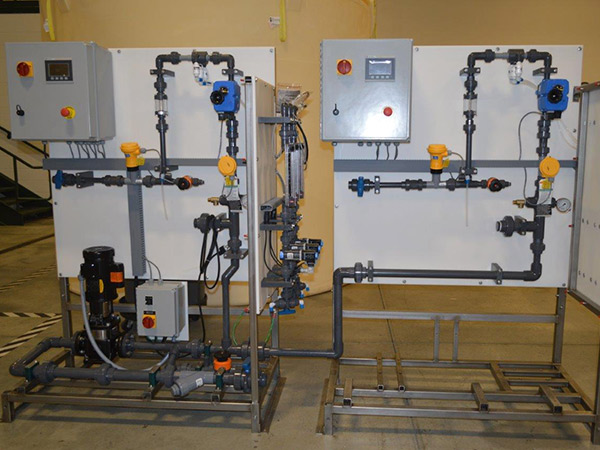
A new dual-generator system provided safe, scalable dosing while integrating with the facility’s SCADA controls and safety protocols. Learn how chlorine dioxide helped streamline compliance, performance, and reliability.
Choose the North American Leader in Chlorine Dioxide
At International Dioxcide, we’ve helped industrial and commercial clients implement chlorine dioxide programs for more than 80 years. As North America’s leading producer of chlorine dioxide, we provide:
- Expert consultation and site assessments
- Tailored chlorine dioxide generation systems
- On-site support and safety training
- Regulatory and environmental compliance guidance
Our team understands the complexity of cooling tower water treatment chemicals and works closely with engineers, facility managers, and water treatment partners to deliver real results — safely, efficiently, and cost-effectively.
